Transport Ticketing and Payment Systems: How We Design Scalable Solutions
Why Transport Payments Are an Infrastructure Problem, Not a Feature
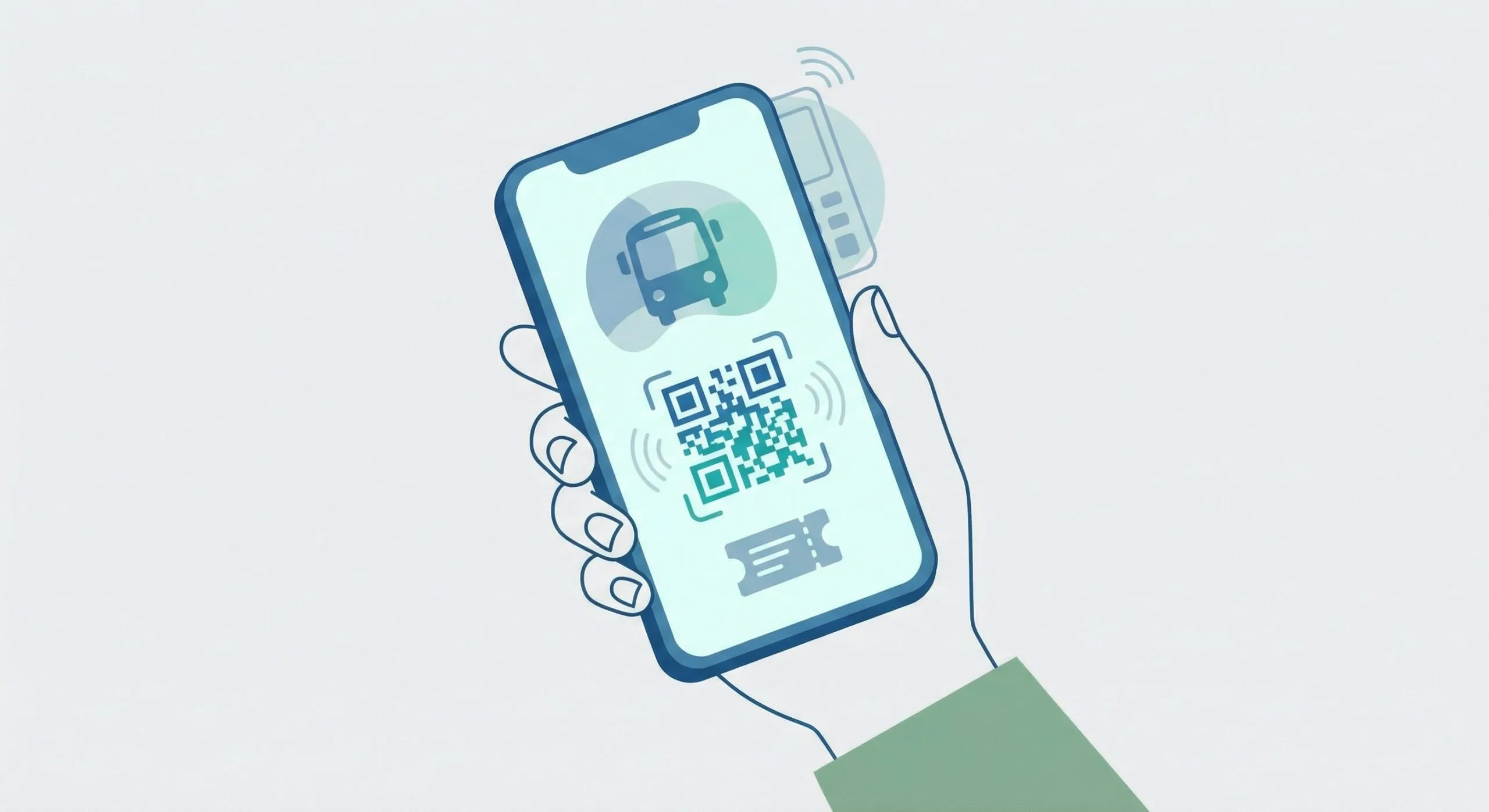
When a city or a transport operator decides to "add online ticketing," the conversation often starts as if it were a small e-commerce task: a payment button, a confirmation screen, done. In reality, transport ticketing sits much closer to banking infrastructure than to a typical online shop. The system must accept fares at gates and turnstiles, on buses, inside mobile apps, and at vending kiosks — frequently all at once, during the morning rush, when thousands of passengers tap a card or scan a QR code within the same few minutes.
That concentration of load is what makes the domain difficult. A retail store can tolerate a checkout that takes three seconds. A turnstile cannot: if validation is slow, a queue forms physically, people miss their bus, and trust in the system erodes after a single bad morning. The core engineering goal is therefore not "process a payment" but "validate the right to travel reliably, fast, and even when the network is down."
The Architecture We Recommend: Separate Validation From Settlement
The most important design decision in transport ticketing is to decouple the act of letting a passenger through from the act of moving money. These are two different problems with two different sets of requirements, and merging them is the root cause of most failures we see in the field.
Validation must be near-instant and able to work offline. Settlement — charging the card, reconciling with the bank, splitting revenue between routes or operators — can be eventually consistent and run asynchronously in the background. A passenger should never wait at a gate for a bank acquirer to respond.
Key design choice: Treat the validator (turnstile, bus device, gate) as an authority that can make a local accept/deny decision in milliseconds using cached fare rules and a local list of allowed media. Push transactions to a central back office afterwards, and run all financial settlement there. The validator's job is the door; the back office's job is the money.
This pattern is sometimes called "account-based ticketing" (ABT): the card or phone is just an identifier, and the actual balance, pass, and fare logic live in the cloud. ABT scales far better than storing value directly on the card, because it lets you change fares, add discounts, or fix mistakes centrally without reissuing physical media.
Designing for Peak Load, Not Average Load
Average daily transaction counts are almost useless for capacity planning in transport. What matters is the peak: the 8:00–9:00 a.m. window when a large share of the entire day's taps happen in a narrow band. We design and size systems against that peak with a comfortable safety margin, not against the daily average.
Practical implications for the architecture:
- Idempotency everywhere. Mobile networks on buses are unreliable. A validator will retry sending the same tap. Every transaction needs a unique client-generated ID so the back office can deduplicate and never double-charge.
- Write-optimized ingestion. The pipeline that receives taps should accept and queue them quickly (append-only), then process fare calculation and settlement downstream. Don't make the device wait on heavy business logic.
- Horizontal scalability. The ingestion and settlement services should scale out across instances, with the database designed so a single hot table doesn't become the bottleneck during rush hour.
- Backpressure and graceful degradation. If the back office is overloaded, validators keep working from their local rules and buffer transactions. The system degrades into "offline mode" instead of refusing passengers.
Offline Mode Is Not Optional
This is the requirement most often underestimated. Buses go through tunnels and dead zones; a city subway may have intermittent connectivity at platforms. A validator that depends on a live server call for every tap will fail in exactly these situations — and it will fail at the worst possible moment, with a queue behind it.
A robust validator keeps a local copy of fare rules and a regularly synchronized list of blocked or allowed media. It makes the decision locally, stamps the transaction, stores it, and forwards it once connectivity returns. The reconciliation of those delayed transactions then happens server-side, including handling the edge case of a card that was valid when tapped but turned out to be blocked minutes later.
Common mistake: Designing the turnstile to call the payment gateway synchronously on every tap. This couples passenger throughput to the slowest external dependency you have — the bank. One acquirer slowdown then turns into citywide gate failures and physical queues. Always validate locally and settle asynchronously.
Money, Reconciliation, and Trust
Behind every tap is a financial trail that has to balance to the last sum. In a multi-operator environment — several bus companies, a metro, private routes — fare revenue must be split fairly, and every party will audit the numbers. The back office therefore needs a strict double-entry ledger, daily reconciliation against the acquiring bank's settlement files, and the ability to explain any discrepancy down to a single transaction.
For Uzbekistan specifically, this means integrating cleanly with local payment rails (Uzcard, Humo) and national systems alongside any card-not-present flows in the mobile app. Each integration has its own settlement timing and reconciliation format, and the system must normalize them into one consistent ledger. We also recommend designing reporting from day one: operators and regulators will want transparent, exportable revenue and ridership data, and bolting that on later is painful.
Security and Anti-Fraud
Transport systems are a constant target for fare evasion and cloned media. Storing value on the card invites cloning; account-based ticketing reduces that risk by keeping balances server-side. Communication between validators and the back office must be encrypted and mutually authenticated, and devices should be provisioned with rotating keys, not a shared secret baked into firmware. Sensitive cardholder data should never touch your own servers unnecessarily — push it to a PCI-compliant gateway and keep only tokens.
Equally important is the audit trail. Every fare rule change, every refund, every manual override should be logged with who, when, and why. In a system that handles public funds, the ability to prove what happened is as valuable as the ability to make it happen.
Card-based vs account-based ticketing
- Card-based (value on card): works fully offline by design, but hard to update fares, vulnerable to cloning, and painful to fix errors — every change touches physical media.
- Account-based (value in cloud): central control of fares, discounts and blocklists; easier fraud handling and analytics; requires solid offline caching on validators and a strong back office, but scales and evolves far better. For new deployments we almost always recommend account-based.
Phasing the Build
You do not have to launch everything at once, and you shouldn't. A sensible path is: first a reliable validation-and-ingestion core with one payment method and solid offline support; then settlement, reconciliation, and reporting; then passes, discounts, loyalty, and multi-operator revenue sharing. Each phase is independently testable under real load, which is the only way to be confident the system survives its first rush hour.
Conclusion
Scalable transport ticketing comes down to a few disciplined choices: separate validation from settlement, make validators work offline, plan for peak load with idempotent ingestion, and build a back office that reconciles every sum and proves it. Get these right and the system quietly handles millions of taps; get them wrong and the failure shows up as queues, lost revenue, and lost trust. If you are planning a ticketing or fare-collection project — for a city, a transport operator, or the public sector in Uzbekistan — the OneDev team would be glad to review your requirements and help you design an architecture that holds up under real-world load. Let's discuss your project.