IoT and Automation Platforms: How Systems Work from the Inside
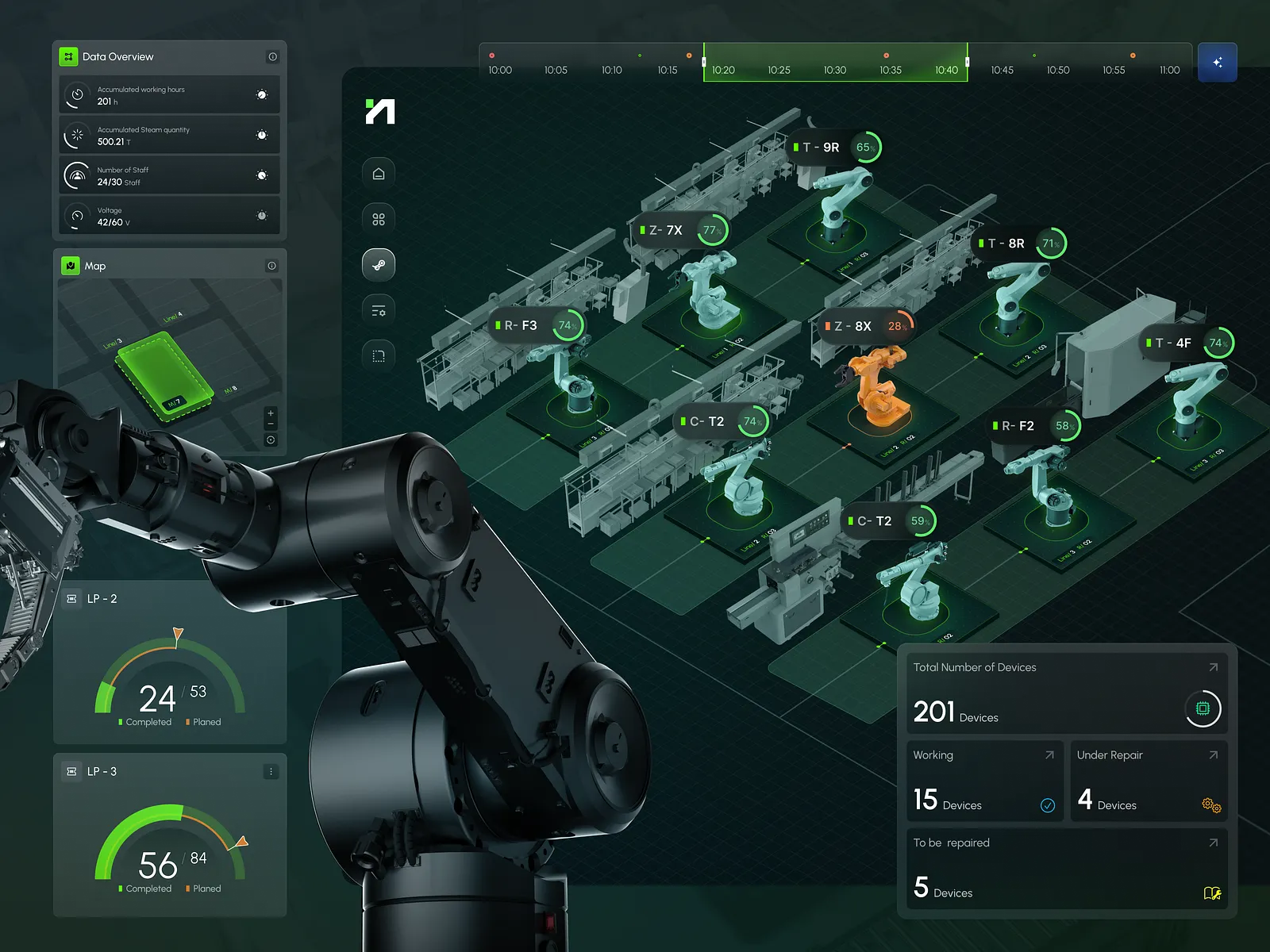
What an IoT Platform Actually Is
From the outside, an IoT platform looks deceptively simple: a sensor sends a number, a server stores it, and a dashboard shows a chart. In reality, what you are looking at is not a single application but a distributed system — a chain of tightly coupled components that must operate continuously and in near real time. Devices in the field, network gateways, message brokers, stream processors, databases, business logic, and user-facing applications all depend on one another. If any single link degrades, the symptoms usually surface somewhere completely different: a dashboard freezes, an alert never fires, or readings silently stop updating while everything "looks" online.
Understanding this internal chain matters because most IoT problems in production are not "device problems." They are integration problems — timing, ordering, buffering, and state synchronization between layers. For a business or a government agency in Uzbekistan deploying utility metering, fleet tracking, cold-chain monitoring, or building automation, knowing how the parts fit together is the difference between a system you can trust and one you constantly firefight.
The Layers: From Sensor to Decision
A practical way to reason about an IoT platform is to break it into distinct layers, each with its own failure modes and its own responsibilities. Data flows upward from the physical world toward decisions, and commands flow back down toward devices.
- Device and edge layer. Sensors, controllers, and microcontrollers acquire readings. The edge often pre-filters, batches, and buffers data so the system survives network drops. This is where firmware quality, local storage, and time synchronization live.
- Connectivity layer. The transport that moves data — typically MQTT, CoAP, HTTP, or LoRaWAN/NB-IoT for low-power devices. This layer handles authentication, encryption, and reconnection logic.
- Ingestion and messaging layer. A broker or message queue (MQTT broker, Kafka, RabbitMQ) absorbs bursts of incoming traffic and decouples fast-arriving device data from slower downstream processing.
- Processing layer. Stream processors validate, enrich, deduplicate, and aggregate raw events. Rules engines evaluate conditions and trigger alerts or automation commands.
- Storage layer. Time-series databases keep raw telemetry; relational or document stores keep device metadata, users, and configuration.
- Application and presentation layer. APIs, dashboards, mobile apps, and integrations with ERP, billing, or SCADA systems where humans and other systems actually consume the results.
The crucial insight is that these layers run at very different speeds and reliability levels. A device may emit one reading per second; a database write may take milliseconds but occasionally stall; a user opens a dashboard once a day. The platform's real job is reconciling these mismatched rhythms without losing data or breaking ordering.
How Data Really Moves Through the System
Follow a single temperature reading from a refrigerated warehouse. The sensor measures, the edge controller timestamps it and publishes an MQTT message to a broker. The broker does not process the value — it simply accepts it and holds it for subscribers. A stream processor subscribes, validates that the timestamp and value are plausible, enriches the message with device location and asset ID from a metadata store, and writes the raw point to a time-series database. Simultaneously, a rules engine checks: is the temperature above the threshold for longer than the allowed window? If yes, it raises an alert and may send a command back down to a cooling unit.
Notice how much happens between "device sent data" and "user sees result." Each hop introduces latency and a chance of failure. The broker decouples ingestion from processing precisely so a slow database or a redeployed service does not cause the device to lose data — messages queue up and drain when the downstream recovers. This buffering is what makes an IoT platform resilient, and it is also the most misunderstood part of the architecture.
State, Time, and Ordering — Where Most Systems Break
The hardest problems in IoT are not about moving bytes; they are about time and state. Devices have unreliable clocks, networks reorder and delay messages, and a single device can be represented in three places at once: its last reported value, its desired configuration, and the historical record. Keeping these consistent is non-trivial.
Consider clock skew. A device whose clock drifts into the future or the past will produce readings with timestamps that look valid but land in the wrong place on a chart — or get filtered out entirely. A robust platform stores both the device-reported time and the server-received time, and filters or queries against whichever is trustworthy for the use case. Relying on device time alone is a classic source of "missing data" that is not actually missing.
Then there is the digital twin or "device shadow" — a server-side representation of each device's last known and desired state. When a user changes a setpoint while a device is offline, the platform must store the intent and reconcile it when the device reconnects. Without this, commands silently disappear and users lose trust in the controls.
Automation and the Rules That Drive It
Automation is where an IoT platform stops being a logging tool and starts delivering value. A rules engine continuously evaluates incoming events against conditions and executes actions: send a notification, write to another system, or issue a command back to a device. The design question is where this logic should live — in the cloud, at the edge, or both.
Cloud-side rules are flexible and easy to change, but they depend on connectivity and add latency. Edge-side rules react in milliseconds and keep working when the network is down, but they are harder to update across a large fleet. Safety-critical automation — shutting off a valve, cutting power, triggering an alarm — almost always belongs at the edge, with the cloud providing oversight, configuration, and audit. Convenience and analytics automation can live in the cloud.
Designing for Failure, Scale, and the Real World
Every layer of an IoT platform will fail at some point, so the design must assume failure rather than hope to avoid it. Practical patterns that separate reliable platforms from fragile ones include idempotent message handling (so a re-sent reading does not create a duplicate), backpressure (so a slow database slows ingestion gracefully instead of crashing), local buffering on devices (so a network outage delays but never deletes data), and observability built in from day one.
Scale changes the rules. A pilot with 50 devices behaves nothing like a deployment of 50,000. At scale, time-series storage costs, broker throughput, and per-device connection limits become the binding constraints. It is far cheaper to choose a time-series database and a buffered architecture early than to re-platform after the data volume has already grown. Security must also be designed in, not added later: per-device credentials, encrypted transport, signed firmware updates, and the ability to revoke a compromised device without taking down the fleet.
- Plan retention and aggregation early — raw, high-frequency data is expensive to keep forever; downsampled rollups serve most dashboards.
- Make every device individually identifiable and revocable — shared credentials are a breach waiting to happen.
- Instrument the pipeline end to end — you cannot operate what you cannot measure.
- Test reconnection and offline behavior deliberately, not just the happy path.
Conclusion
An IoT and automation platform is only "simple" when nothing goes wrong. Inside, it is a real-time chain of devices, brokers, processors, and stores that must agree on time, state, and ordering while individual parts fail and recover. The platforms that earn trust are the ones designed around buffering, observability, edge-versus-cloud automation, and security from the start — not bolted on afterward. If you are planning a metering, monitoring, fleet, or building-automation project and want an architecture that holds up in production rather than just in a demo, the team at OneDev would be glad to review your requirements and help you design the system the right way from the inside out. Let's discuss your project.