How We Develop Digital Platforms from Scratch: From Idea to Launch
Why "From Scratch" Is a Strategic Decision, Not a Technical One
Most businesses in Uzbekistan do not actually need a digital platform built from zero. They need a result: orders captured automatically, employees freed from manual reconciliation, customers self-serving online, or a recurring revenue stream from a SaaS product. Building from scratch only makes sense when off-the-shelf tools genuinely cannot deliver that result — when your processes are non-standard, your data is sensitive, your integrations are local (banking, payment gateways, government systems), or your product itself is the business.
At OneDev we treat "develop a platform from scratch" as a chain of decisions, each of which either compounds value or quietly accumulates cost. The code is the easy part. The hard part is making sure that what we build is the thing the market will pay for, and that it can grow without being rewritten every eighteen months. This article walks through how we move a project from a rough idea to a live, scalable product — and where most platform initiatives go wrong.
Stage 1: Discovery and Problem Framing
Before a single line of code, we spend time understanding the business mechanics. Not "what features do you want," but "what is the measurable problem, who suffers from it today, and what does success look like in numbers." A platform is justified only if it changes a real metric: time per transaction, cost per lead, churn, error rate, or capacity to serve more clients without hiring proportionally.
In discovery we map the current process end to end, identify the people who touch it, and locate the bottleneck. We also surface constraints early: legal requirements, data residency, existing systems that must be integrated, and the realities of the local market — payment providers, fiscalization, language and localization needs (Uzbek, Russian, English), and connectivity assumptions for users outside major cities.
Stage 2: Defining the MVP and the Scalable Architecture Underneath
An MVP is not a low-quality version of the product. It is the smallest set of capabilities that lets real users complete the core job and lets the business start learning. The discipline is to keep the user-facing scope small while keeping the foundation serious. These two ideas are easy to confuse.
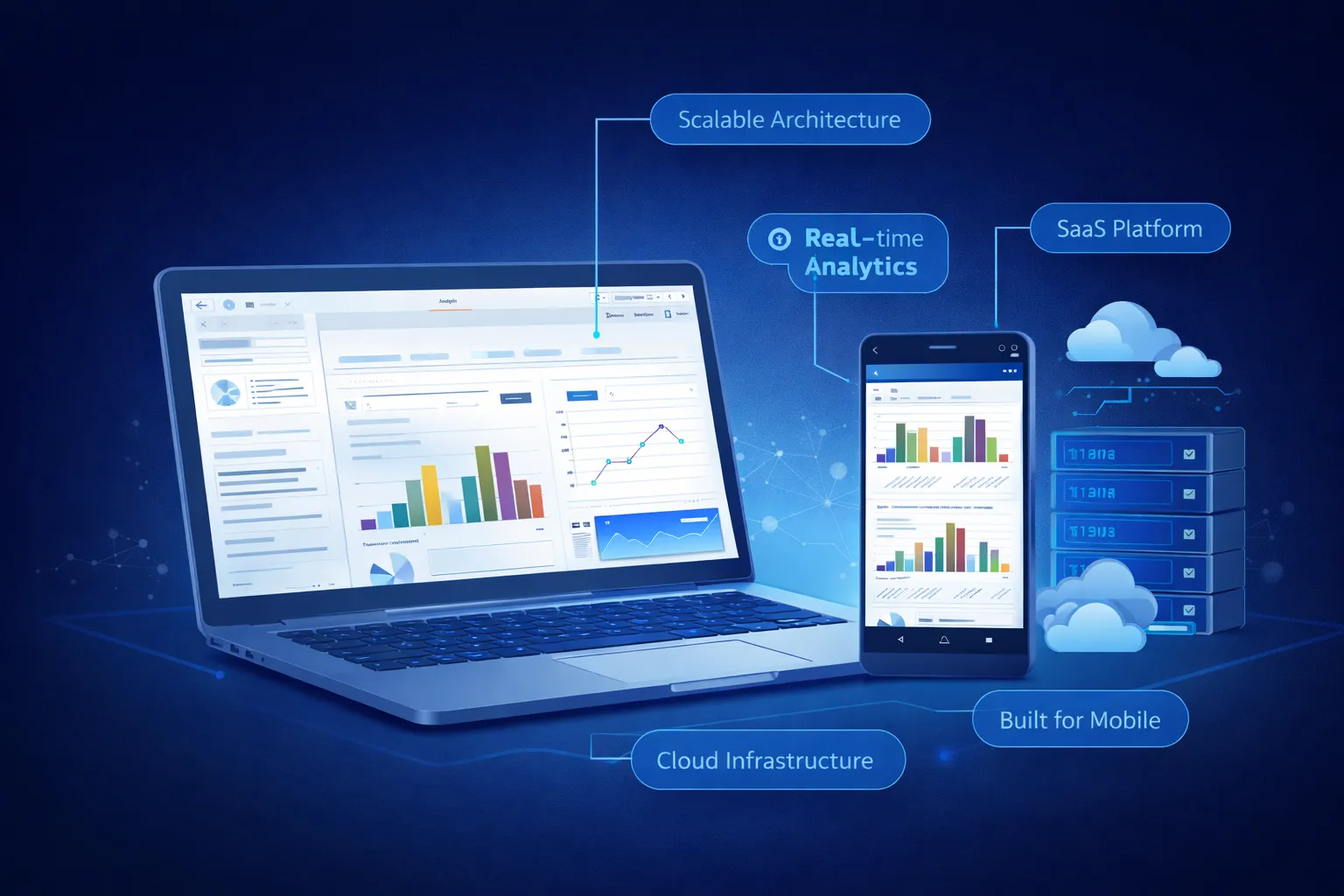
Concretely, that means we design the data model, authentication, roles, and integration boundaries as if the product will scale — because changing those later is expensive — while shipping only the features needed to prove value. We choose a stack we can maintain and hire for, we separate the API from the front end so web and mobile clients can share one backend, and we plan for multi-tenancy from the start if the product is SaaS.
- Data first: a clean, normalized schema with clear ownership rules prevents the most painful refactors later.
- Stateless services where possible: so that scaling horizontally is a configuration change, not a rewrite.
- Integration as contracts: payment, SMS, accounting, and government APIs are wrapped behind interfaces, so a provider change does not ripple through the whole codebase.
- Observability from day one: logging, error tracking, and basic metrics are part of the MVP, not a future "nice to have."
Stage 3: Iterative Development with Visible Progress
We build in short cycles with working software at the end of each one. This is not ceremony for its own sake — it exists so the client sees real screens and real data early, and so course corrections happen while they are cheap. A platform that is demonstrated only at the end is a platform built on assumptions that were never tested.
Each iteration is scoped around a usable slice: not "build the database this week, the UI next month," but "let a user register, create an order, and see it in an admin panel." Quality practices — code review, automated tests on critical paths, and a staging environment that mirrors production — run continuously rather than being saved for a "stabilization phase" that, in practice, never gets enough time.
Stage 4: Security, Compliance, and Data Ownership
For B2B and public-sector platforms, security is not a feature — it is a precondition for being allowed to operate. We design role-based access from the start, encrypt sensitive data in transit and at rest, keep secrets out of source code, and maintain audit trails for actions that matter. For platforms handling personal data, we account for local data-protection expectations and, where relevant, keep data hosted in-country.
Equally important is ownership. The client owns the source code, the infrastructure accounts, the domains, and the data. We document deployment so the platform is never hostage to a single vendor or a single engineer. A platform you cannot redeploy without the original developer is a liability, regardless of how well it runs today.
Stage 5: Launch, Then Scale Based on Evidence
Launch is the beginning of the real work, not the finish line. We launch into a monitored environment, watch the first real load, and fix what production reveals — because production always reveals something a staging environment cannot. Scaling decisions then follow evidence: we scale the parts that are actually under pressure rather than over-engineering for traffic that may never arrive.
Scale prematurely — microservices, multiple databases, and complex orchestration before there are users — and you pay in slower delivery, higher costs, and harder debugging, often for load you never reach.
Scale reactively but on a sound foundation — a clean monolith or modular service with good data design — and you add capacity (caching, read replicas, queues, horizontal instances) exactly where metrics show you need it. This is almost always the cheaper and faster path for a young product.
The reason this works is that we invested in the foundation during the MVP. Scaling becomes an operational task — add a cache here, a read replica there, a queue for heavy jobs — instead of an architectural emergency.
Common Reasons Platforms Fail (and How We Avoid Them)
- Building features nobody validated. We tie every feature to a metric or a confirmed user need before it is scheduled.
- Underestimating integrations. Local payment, fiscal, and government integrations carry real-world quirks; we prototype the riskiest one early.
- No clear owner of data and decisions. We define who owns each entity and who signs off on scope per iteration.
- Hidden lock-in. Documented infrastructure and client-owned accounts keep the business in control.
- "Big bang" launches. We prefer a small, monitored launch and fast iteration over a single high-risk release.
Conclusion
Developing a digital platform from scratch is less about writing code and more about making the right decisions in the right order: framing the real problem, scoping a small MVP on a serious foundation, building in visible iterations, baking in security and ownership, and scaling on evidence rather than fear. Done this way, a platform launches faster, costs less to maintain, and grows with the business instead of fighting it. If you are weighing whether to build a custom platform, automate a process, or turn an internal tool into a SaaS product, the OneDev team is glad to look at your specific case and tell you honestly what is worth building — and what is not. Reach out to discuss your project with us.