GPS Tracking, Dispatching, and Transport Analytics: Architecture of Modern Systems
Why Basic GPS Tracking Is No Longer Enough
Most fleet-driven organizations begin their telematics journey the same way: a GPS tracker in each vehicle, a map showing dots in motion, route history, and an ignition or fuel sensor. For a small fleet, that is often enough. You can see where a vehicle is, confirm that a driver visited a site, and review yesterday's track. But the moment operations scale — more vehicles, more drivers, more regions, tighter margins, and contractual SLAs — this basic layer stops answering the questions that actually drive the business.
The shift is fundamental. Basic tracking answers "where is the vehicle?" Modern transport platforms answer "is this trip profitable, on time, safe, and compliant — and what should dispatch do about it right now?" Those are different problems. They require a different architecture, not just an extra report bolted onto an off-the-shelf tracking portal.
In practice, growing companies in Uzbekistan and the wider region hit a recurring wall: real-time dispatching needs that spreadsheets can't handle, fuel and downtime costs that no one can attribute precisely, customer demands for accurate ETAs, and management asking for analytics that the tracking vendor simply does not expose. At that point the question changes from "which tracker do we buy?" to "how do we architect a system we own?"
The Three Layers of a Modern Transport System
A mature platform is best understood as three cooperating layers. Confusing them is the most common reason projects stall: teams buy a tracking layer and expect dispatching and analytics to appear for free.
- Telemetry and ingestion. Devices and sensors stream raw events — coordinates, speed, ignition, fuel level, temperature, door status, driver ID, CAN-bus data. This layer must reliably receive, parse, and normalize messages from heterogeneous hardware over protocols like the common tracker dialects, and it must keep working when connectivity is intermittent.
- Operational logic and dispatching. This is where raw points become meaningful: trips, stops, geofence entries, assignments, ETAs, exceptions, and alerts. Dispatchers act here. This layer is the heart of the business and almost always needs custom rules specific to your operation.
- Analytics and reporting. Historical and aggregated data turned into decisions: cost per kilometer, utilization, fuel anomalies, driver behavior scoring, SLA compliance, and forecasting. This layer feeds management, not the dispatcher.
Each layer has different performance characteristics. Ingestion is write-heavy and latency-sensitive. Dispatching is read-and-write with strict real-time expectations. Analytics is read-heavy over large historical volumes. Designing them as one monolithic database is the classic mistake that surfaces only after a year of data accumulates.
Telemetry Ingestion: The Foundation Everything Rests On
The ingestion layer determines whether the rest of the system can be trusted. If positions arrive late, duplicated, or out of order, every downstream feature — ETAs, geofencing, fuel reports — inherits the error. Several engineering realities deserve attention here.
First, devices are unreliable by nature. Vehicles drive through tunnels, parking structures, and areas with weak mobile coverage. Trackers buffer data and dump it in bursts when the connection returns, meaning your backend regularly receives points with timestamps from hours earlier. The system must order events by device time, not arrival time, and reprocess trips when late data lands.
Second, hardware is heterogeneous. A real fleet rarely uses a single tracker model. A robust ingestion service abstracts protocol decoding behind a clean internal event format, so adding a new device model is a parser change, not a platform rewrite.
Third, raw GPS is noisy. Coordinates jump, speed spikes appear at standstill, and signal drift creates phantom movement. Map-matching, filtering, and stop detection belong in this layer so that the data handed to dispatching and analytics is already clean.
A frequent and expensive mistake: storing every raw point in the same operational database that dispatchers query in real time. Within months, tables grow to hundreds of millions of rows, queries slow down, and the live map starts lagging. Separate hot operational storage from cold historical storage from the start, and decide your data retention and aggregation policy before launch — not after performance collapses.
Dispatching: Where Real-Time Decisions Happen
Dispatching is the layer most poorly served by generic tracking portals, because it is the most business-specific. A logistics operator, a passenger-transport company, a utility service fleet, and a government inspection fleet all dispatch differently. The data model is similar; the rules are not.
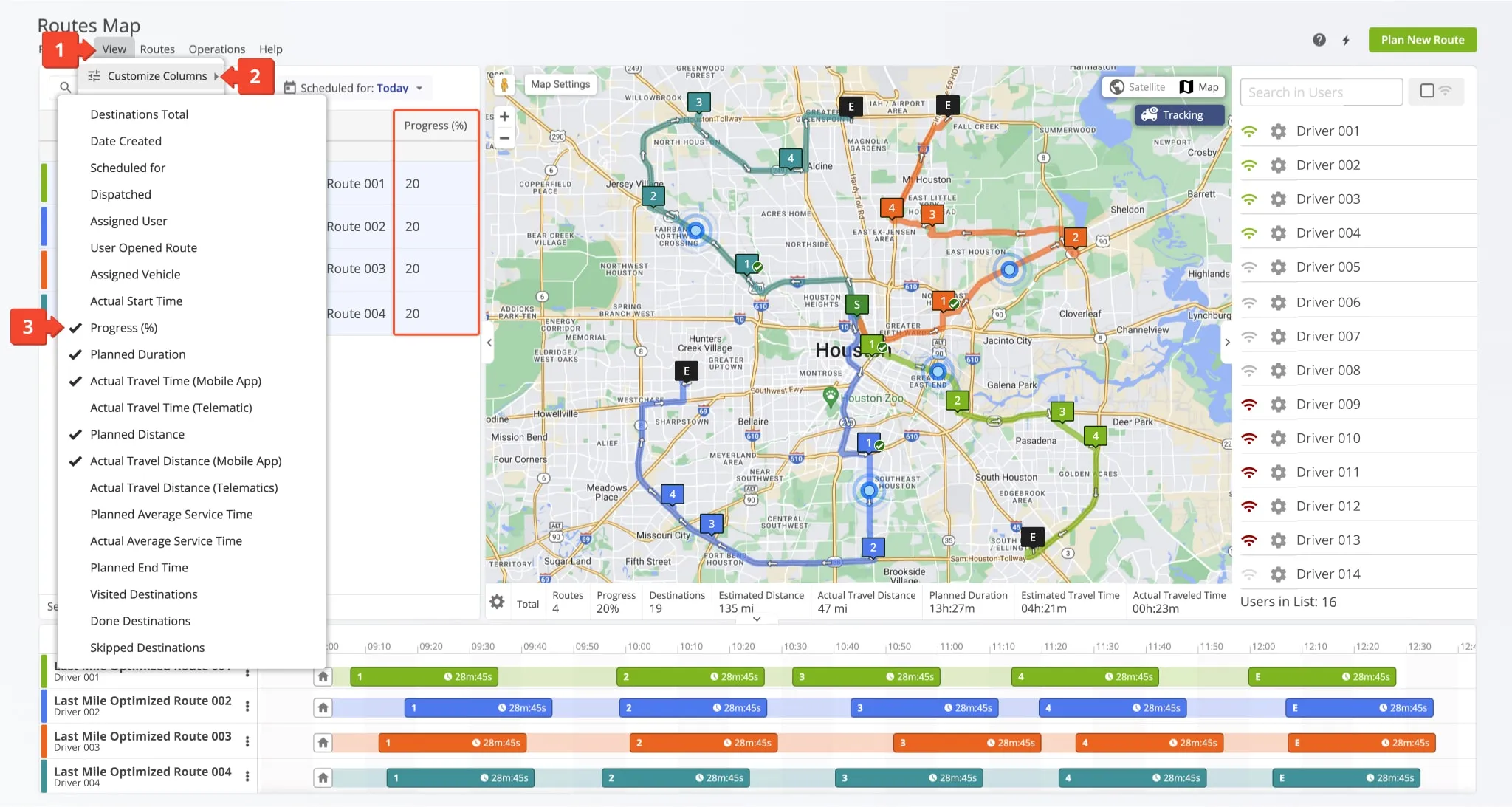
Effective dispatching combines live position with context: which job is assigned to which vehicle, what the planned route and time window are, and what counts as an exception. The value is in the deviations — a vehicle idling too long, a route departure, a missed time window, an entry into a restricted geofence, an unexpected stop. The system should surface these proactively to dispatchers rather than forcing them to stare at a map and notice problems by eye.
Real-time delivery to the dispatcher's screen is a genuine engineering concern. Pushing updates over websockets or a similar streaming channel, debouncing position updates so the UI stays responsive with hundreds of moving units, and keeping ETAs continuously recalculated against live traffic and remaining route — these are the details that separate a usable dispatch console from a laggy demo.
Build versus buy is decided at this layer. If your dispatching needs are generic and your differentiation is elsewhere, an off-the-shelf platform may suffice. But if dispatching logic is your competitive edge — custom assignment rules, integration with your ERP or billing, region-specific compliance, your own customer-facing ETA portal — a custom or hybrid system pays back quickly. The honest test: list the exceptions and rules you need, then check how many your candidate platform supports without workarounds.
Analytics: Turning Movement Into Money
The analytics layer is where the investment justifies itself to management. Position history alone is not analytics. The questions that matter are economic and operational: What is the true cost per kilometer per vehicle? Which routes consistently miss time windows? Where is fuel disappearing — to theft, idling, or inefficient routing? Which drivers exhibit risky behavior, and is it correlated with incidents and maintenance cost?
Answering these requires combining telematics with non-telematics data: fuel-card transactions, maintenance records, driver rosters, job revenue, and contractual SLAs. This is precisely why integration with existing business systems is a core architectural requirement, not an afterthought. Analytics that live in a silo, disconnected from financial and operational data, produce charts that no one acts on.
A practical principle: design analytics around decisions, not around available data. Start from "what action will this report trigger?" If a metric does not change a dispatching rule, a maintenance schedule, a driver conversation, or a route plan, it is decoration. This discipline keeps reporting lean and adopted.
Architecture Patterns and Common Pitfalls
A few patterns repeat across successful systems and across failed ones. Knowing them upfront saves a costly second build.
- Event-driven core. Treat each telemetry message as an event flowing through ingestion, enrichment, rule evaluation, and storage. This decouples layers and lets you scale or replace each independently.
- Separate storage tiers. Hot store for live dispatching, time-series or columnar store for historical analytics, and an aggregation pipeline that rolls up raw points into trips and daily summaries.
- Idempotent, replayable processing. Because late and duplicate data are guaranteed, trip computation must be re-runnable so a corrected history is always available.
- API-first integration. Expose clean APIs so ERP, billing, customer portals, and BI tools can consume data without touching the core database directly.
Off-the-shelf tracking portal — fast to start, low upfront cost, fixed feature set, limited custom dispatching logic, analytics constrained to vendor reports, integration via whatever API the vendor offers, and your data lives in their system.
Custom or hybrid platform — higher initial investment, full control over dispatching rules and analytics, deep integration with your ERP and financials, data ownership, and the ability to evolve as operations grow. The right choice when transport is core to your business rather than a side function.
One more pitfall worth naming: underestimating the operational discipline a platform demands. Geofences must be maintained, device firmware updated, sensors calibrated, and data quality monitored. A technically excellent system degrades into noise if no one owns its upkeep. Budget for operations, not just for the build.
Conclusion
Basic GPS tracking tells you where your vehicles are. A modern transport platform tells you whether your operation is efficient, safe, on time, and profitable — and gives dispatchers the means to fix problems before customers notice them. The difference lies in architecture: a reliable ingestion layer, business-specific dispatching logic, and analytics wired into your real financial and operational data. Each layer has distinct demands, and conflating them is the most common reason projects underdeliver. If your fleet has outgrown dots on a map and you are weighing how to build a system you actually own and integrate, the OneDev team is glad to discuss your operation, map your requirements layer by layer, and help you choose a build, buy, or hybrid path that fits your scale and budget.